






Lebanese, not translated
A dedicated Lebanese Arabizi layer handles spelling, code-switching, gender and person agreement, and local phrasing that generic Arabic models miss.
Built to help you move forward
My Hayat is not optimized to keep a conversation going forever. Its job is to help you understand what is happening, build skills, and reconnect with your own decisions.
Safety before fluency
High-risk language is handled deterministically before the model generates. Ordinary replies are checked before display for dialect failures, script mismatches, and reasoning leaks — with retry and conservative fallback when needed.



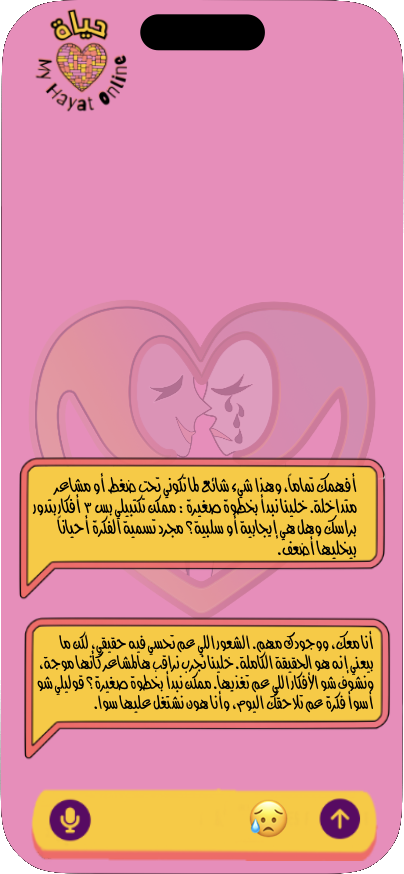


What good support should feel like
Design goals for the My Hayat prototype — not attributed user quotes.

Design goal
""It understood what I meant without correcting the way I type.""

Design goal
""It asked one useful question instead of giving me a ten-step routine.""

Design goal
""It helped me name the pattern, then let me decide what to do.""

Design goal
""It stayed on the topic I brought — not the topic it preferred.""

Design goal
""It never pretended the conversation was enough on its own.""

Design goal
""It felt like a first conversation, not a script.""
Design goal
""It understood what I meant without correcting the way I type.""
Design goal
""It asked one useful question instead of giving me a ten-step routine.""
Design goal
""It helped me name the pattern, then let me decide what to do.""
Design goal
""It stayed on the topic I brought — not the topic it preferred.""
Design goal
""It never pretended the conversation was enough on its own.""
Design goal
""It felt like a first conversation, not a script.""

faq.title faq.titleHighlight
faq.subtitle
Is My Hayat therapy?
No. My Hayat is a mental-health support prototype. It can help with reflection, psychoeducation, and practical coping tools, but it does not diagnose, treat, or replace a licensed professional.
Why Lebanese Arabizi?
Because language is part of the barrier. Many Lebanese conversations naturally move between Arabic, English, French, and Arabizi. My Hayat is being built for that reality rather than forcing people into formal Arabic or perfect English.
What happens if the AI gets the dialect wrong?
The language pipeline checks generated replies for known Egyptian leakage, invented forms, script mismatches, and other quality failures. A failed response is retried on a different model, and repeated failures fall back to conservative wording.
What happens in a crisis?
High-risk messages are handled by deterministic safety logic rather than relying only on a generative model. My Hayat is not an emergency service — it surfaces local crisis resources and stays present, but it is not a substitute for emergency care.

Judge the conversation,
not the pitch.
My Hayat is still an MVP. The useful question is whether a Lebanese person can open it, type naturally, and feel understood enough to keep going.
We respect your privacy. Unsubscribe anytime.